The Atlantic Fracture.
Why the EU and Canada Refused to Join the NATO Iran Mandate.

The military strikes launched on February 28, 2026, under the designation Operation Epic Fury, did more than merely target the leadership of the Islamic Republic of Iran; they effectively shattered the consensus that has defined the North Atlantic Treaty Organization (NATO) for decades. In the immediate aftermath of the assassination of Supreme Leader Ali Khamenei, a profound diplomatic crisis emerged within the core of the Western alliance. At the center of this storm was a calculated but controversial series of assertions by NATO Secretary General Mark Rutte, who suggested that the alliance would eventually join the United States in its military campaign to reopen the Strait of Hormuz—a suggestion that met with a swift, coordinated, and historically unprecedented rejection from the European Union and Canada. This rejection was not merely a tactical disagreement; it was a fundamental reassertion of national sovereignty and international law against a paradigm of unilateralism that many allies believe threatens the foundations of the rules-based international order.
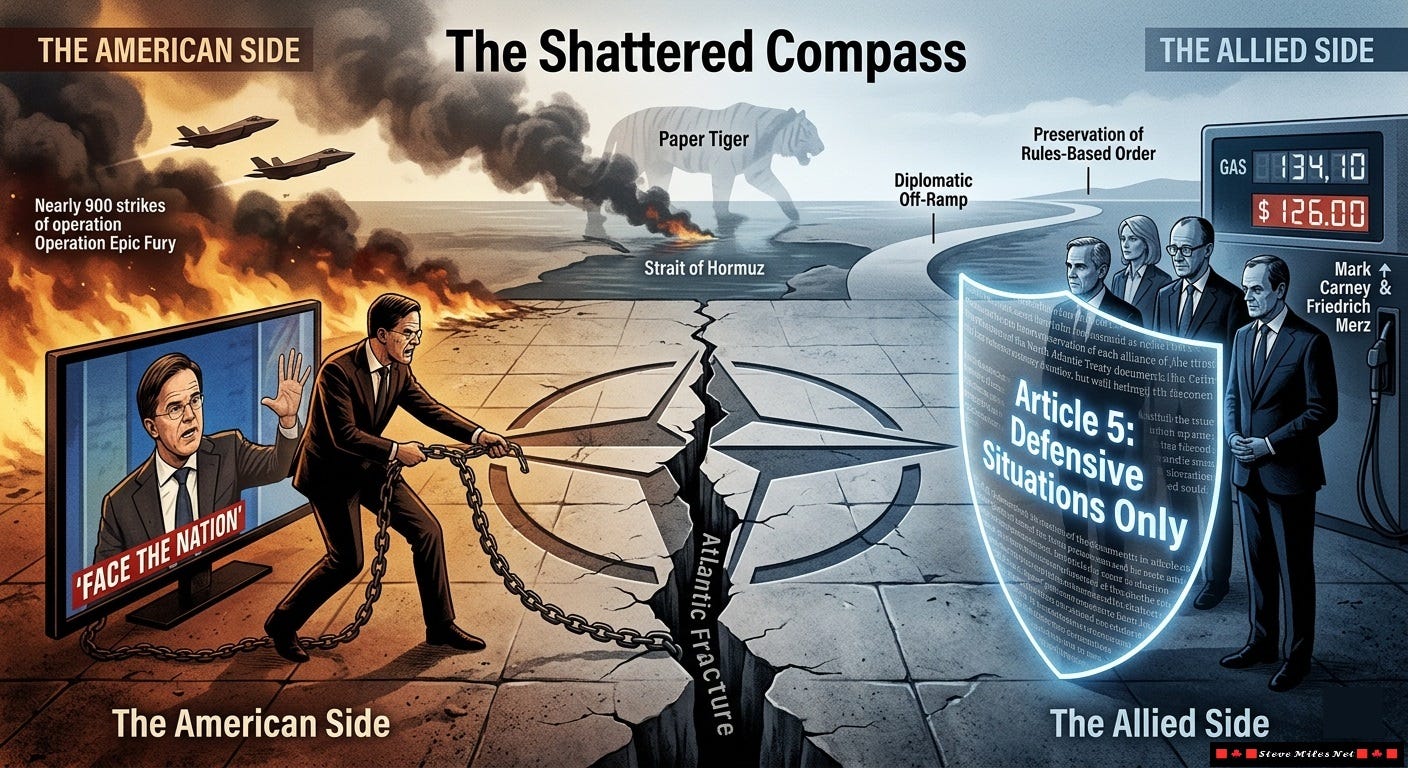
The road to this rupture was paved with a deliberate lack of consultation. The U.S.-Israeli strikes, involving nearly 900 sorties in the first twelve hours, were conducted without prior notice to major NATO allies. Secretary General Mark Rutte’s response revealed the precarious position of NATO leadership in an era of resurgent American nationalism. In high-profile interviews, Rutte attempted to frame the strikes as a necessary action to degrade Iran’s nuclear capabilities. He went as far as to suggest it was “only logical” that European countries would take a few weeks to “come together” under U.S. leadership to secure free sailing in the Strait of Hormuz. This attempt to pivot the alliance toward an offensive war of choice was seen by many in Brussels and Ottawa as an attempt to “bully” allies into a conflict they had neither authorized nor anticipated.
The European response to Rutte’s suggestion was immediate and unified. Germany, France, and Spain issued statements clarifying that there were no plans for NATO involvement in the war. German Defense Minister Boris Pistorius was particularly direct, stating flatly, “This is not our war”. In Spain, Prime Minister Pedro Sánchez took the significant step of refusing to allow U.S. forces to use Spanish bases for operations against Iran, even after threats from Washington to cut off trade relations. This resistance was echoed by the EU’s High Representative for Foreign Affairs, Kaja Kallas, who noted that there was no appetite among member states to expand the mandate of existing naval missions to support the American offensive.
Canada, led by Prime Minister Mark Carney, adopted a position of “strategic regret”. Carney described the strikes as “prima facie” inconsistent with international law and lamented that they were launched without consulting allies. While acknowledging Iran as a destabilizing force, he repeatedly emphasized that Canada would not participate in the offensive. This legal clarity is rooted in a strict interpretation of the North Atlantic Treaty. Article 5 is strictly limited to defensive situations where a member state is subjected to an “armed attack”. Because the United States initiated the hostilities, the subsequent Iranian retaliatory strikes do not trigger the collective defense obligations of the alliance. Furthermore, the conflict falls outside NATO’s defined operational zone in Europe and North America.
The closure of the Strait of Hormuz transformed this regional conflict into a global economic emergency, with oil prices surging to $126 per barrel. President Trump used this shock to increase pressure, warning that if allies did not send ships, it would be “very bad for the future of NATO”. Despite this, the joint statement issued on March 19 by the UK, France, Germany, and Canada was a carefully crafted compromise. While expressing a “readiness to contribute to appropriate efforts” for safe passage, it grounded this commitment in maritime law rather than the strategic goals of the war. This “Atlantic Fracture” marks the end of automatic allied solidarity and the beginning of a more autonomous European and Canadian foreign policy. The rejection of the NATO mandate in Iran was an act of strategic clarity: a reminder that the alliance is a defensive shield, not a tool for unilateral regime change.