The Great Decoupling.
Global Renewable Sovereignty and Canada’s Strategic Crossroads in the 2026 Energy Economy.

The global energy landscape in early 2026 has entered a phase of profound structural divergence, characterized by a “Great Decoupling” of economic growth from carbon intensity. The transition to renewable energy is no longer a peripheral environmental aspiration but the central pillar of national security, industrial competitiveness, and sovereign resilience. Globally, installed renewable energy capacity has reached an unprecedented 3,610 GW, with the world having added a record-breaking 741 GW in 2024 alone. This momentum is fundamentally reshaping the geopolitical order, giving rise to “electrostates”—nations whose influence is increasingly derived from their dominance over clean energy supply chains and high-voltage infrastructure rather than fossil fuel reserves. However, as the world races toward a target of tripling renewable capacity by 2030, a stark reality has emerged: the transition is no longer limited by the cost of generation, which has plummeted by over 90% for solar and batteries since 2010, but by the physical and regulatory limits of the grid.
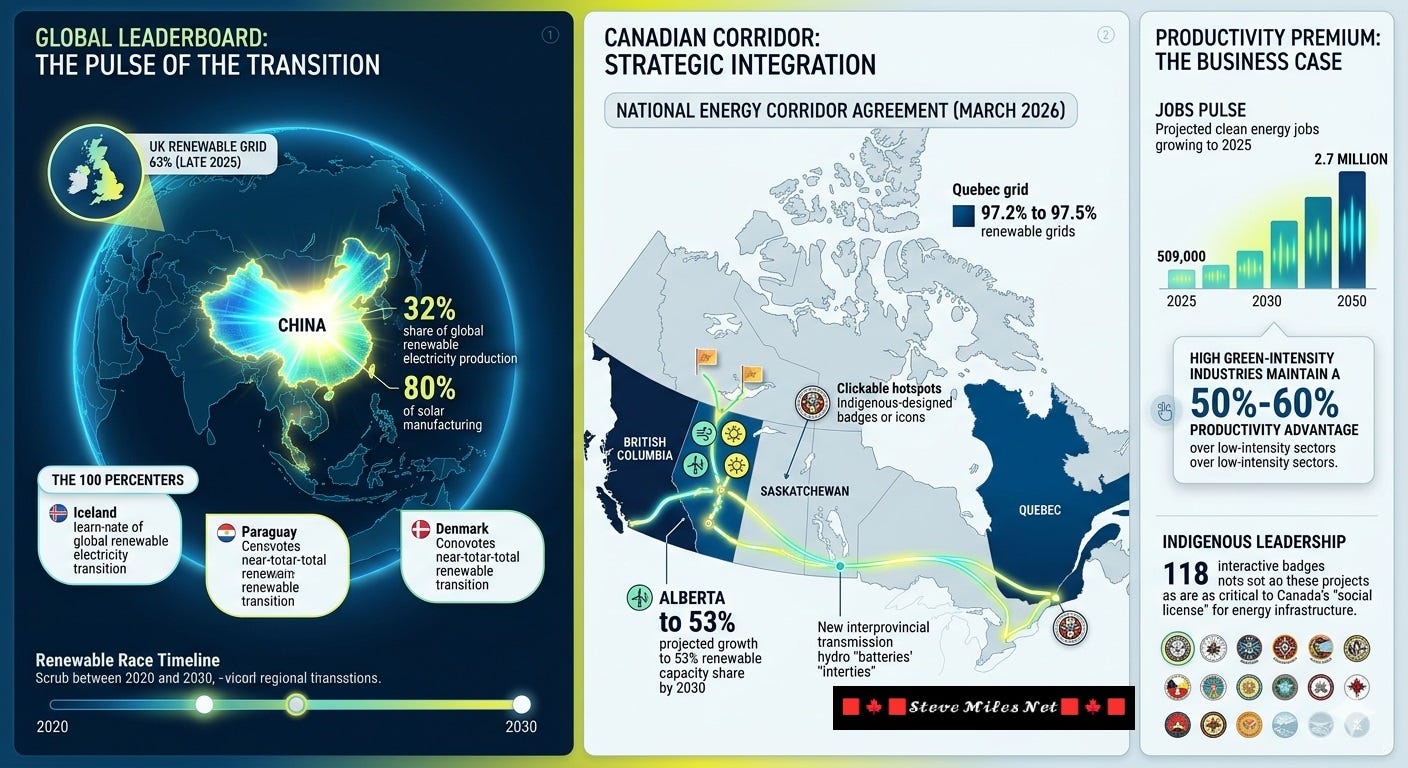
The hierarchy of renewable energy leadership in 2026 is dominated by a small group of nations that have successfully scaled manufacturing and deployment to achieve what was once considered technologically impossible. China remains the undisputed global leader, accounting for 32% of global renewable electricity production as of 2025. Its strategy is built on a massive, vertically integrated industrial base that controls approximately 80% of the global solar manufacturing industry. In early 2025, China added an extraordinary 240 GW of new solar capacity in a single year—a volume larger than the entire installed capacity of many developed nations. By 2026, China’s installed wind capacity reached 570 GW, reinforcing its status as the world’s primary clean energy powerhouse. Despite this dominance, China’s transition remains paradoxical, as it also accounts for 74% of global coal generation growth, highlighting an “integration trap” where current grid infrastructure struggles to absorb variable renewable energy without traditional baseload power.
The United States follows as the second-largest renewable producer, generating over 1,500 TWh annually. The American model is defined by decentralized, state-led initiatives rather than a singular federal mandate. Texas has become a wind energy powerhouse with over 150 GW of capacity, while California has officially transitioned solar into its largest single source of power. Federal and state-level tax incentives have played a critical role in this expansion, though the national grid’s renewable share remains at approximately 30%, as the country’s “energy independent” policy continues to prioritize domestic natural gas. In contrast, the United Kingdom has emerged as a frontrunner among major economies, with a grid that is already 63% renewable, propelled by a strong ecosystem of offshore wind, nuclear, and biomass.
A small but significant group of nations has already achieved near-total decarbonization of their electricity grids. Iceland represents the pinnacle of resource-driven transition, having built a 100% renewable power system by leveraging its location on the volcanic Mid-Atlantic Ridge for geothermal energy and its glacial river systems for hydroelectricity. Paraguay similarly produces 100% of its electricity from hydropower, generating approximately 48 TWh annually, a surplus that has allowed it to become a major regional energy exporter. Other nations like Albania and Bhutan have reached roughly 98% to 100% renewable grids, primarily through hydropower, though they face growing risks from climate-driven changes in water availability. Norway serves as a critical hybrid case, generating 95% of its electricity from hydro while simultaneously leading the world in electric vehicle adoption and deep electrification. Denmark has achieved an 88% renewable share through the aggressive deployment of variable wind energy, which provides 58% of the country’s power.
Canada occupies a unique and somewhat precarious position in this 2026 energy landscape. Historically, Canada is a renewable energy superpower; in 2023, it was the fourth-largest global producer of renewable electricity despite its relatively small population. This leading position is primarily driven by hydroelectricity, which accounts for 58% of national generation and 86% of all renewable production. As of late 2025, approximately 66.3% of Canada’s electricity generation comes from renewable sources, and when including nuclear, nearly 80% of its grid is low-carbon. However, Canada’s “Energy Nation” narrative is currently being challenged. In early 2026, Canada dropped out of the global top 10 for energy transition investment, falling from 8th place in 2024 to 11th as countries like Saudi Arabia surged ahead. While investment in Canadian renewable energy projects grew by 76% in 2025, a 35% decrease in electric vehicle sector spending—driven by policy uncertainty—led to a total investment drop of $1 billion USD compared to the previous year.
The internal provincial fragmentation is a defining characteristic of Canada’s energy system. Hydro-rich provinces like Quebec, British Columbia, Manitoba, and Newfoundland and Labrador typically generate over 85% to 97% of their electricity from hydro. Prince Edward Island generates a staggering 99.1% of its electricity from wind. Conversely, provinces like Alberta, Saskatchewan, and Nova Scotia remain heavily reliant on fossil fuels, though Alberta is currently the site of Canada’s most rapid renewable expansion. Driven by a unique deregulated market and high solar insolation, Alberta is forecast to increase its renewable capacity share from 46.6% in 2025 to 53% by 2030. To address these regional disparities, ten provinces and territories signed the historic “National Energy Corridor Agreement” on March 4, 2026. This partnership aims to transform Canada into an energy superpower by building new interprovincial transmission infrastructure and strategic “interties” that allow variable wind and solar power from the prairies to be balanced by the massive hydroelectric reservoirs of B.C., Manitoba, and Quebec.
The economic imperatives of this transition are becoming impossible to ignore. Research indicates that “high green-intensity industries” in Canada—those involved in professional services, clean construction, and renewable tech—maintain a productivity advantage of 50% to 60% over traditional low-intensity sectors. These green industries have grown by 21% over the last decade, outpacing the broader economy’s 15% growth rate. Furthermore, the employment shift is staggering: in a net-zero scenario, clean energy jobs in Canada are projected to grow by 7% annually, reaching 2.7 million by 2050, while jobs in oil sands and oil production are set to decline by at least 93% by mid-century as global demand peaks. The electric vehicle industry alone is set to employ 1.3 million Canadians by 2050, a 60-fold increase from 2025 levels.
Beyond generation, the transition is increasingly about “Energy Sovereignty” and controlling the technology stack. Canada’s role in this global supply chain is pivotal, as it is a major producer of critical minerals necessary for the green transition, though projects remain hindered by long permitting timelines and capital gaps. Indigenous ownership has emerged as a key solution to these challenges, with 118 Indigenous-owned wind, solar, and energy storage projects already in operation by the end of 2025. Partnerships with First Nations are providing the “social license” needed to build major projects like the $6 billion B.C. North Coast transmission line, which is expected to create 10,000 jobs. Additionally, Canada is positioning itself as a leader in next-generation nuclear technology; the Darlington New Nuclear Project, supported by a $2 billion investment, will make Canada the first G7 country to have an operational, grid-connected Small Modular Reactor (SMR).
In conclusion, the path forward for Canada lies in bridging its provincial divides through the National Energy Corridor and maximizing the “productivity premium” of its growing green industries. While nations like Iceland and Paraguay have already crossed the 100% renewable threshold through geographic luck, and leaders like China and the UK have scaled rapidly through industrial policy, Canada must now overcome its investment hurdles and policy friction. The transition is no longer just about meeting climate targets; it is a race for economic survival in a world where the most powerful nations will be those that can produce, store, and move the cleanest electricity the most efficiently.