The Keystone Pipeline System.
A Comprehensive Analysis of Transcontinental Energy Infrastructure and Geopolitical Conflict.

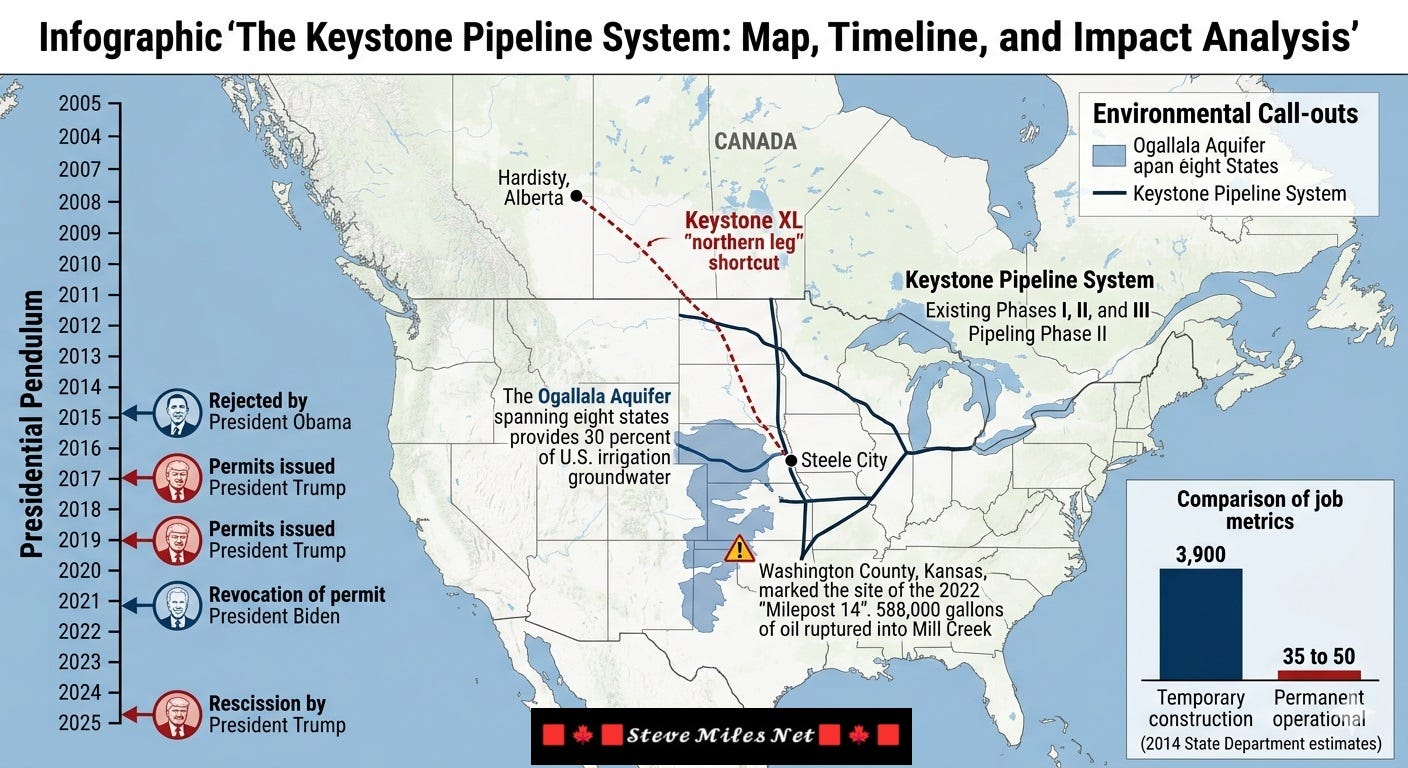
The history of the Keystone Pipeline system represents one of the most complex and divisive chapters in the annals of North American energy development. What began as a strategic industrial endeavor to link the vast bitumen reserves of the Western Canadian Sedimentary Basin with the sophisticated refining clusters of the United States Gulf Coast evolved into a protracted geopolitical struggle. This conflict effectively mirrored the broader global tension between the immediate demands of energy security and the long-term imperatives of climate change mitigation. Spanning four U.S. presidential administrations and nearly two decades of litigation, the pipeline’s trajectory illustrates the shifting priorities of the 21st-century energy landscape, where the traditional metrics of economic utility were increasingly challenged by concerns over indigenous sovereignty, environmental preservation, and international climate leadership.
The conceptual foundations of the Keystone Pipeline were established in early 2005. On February 9, 2005, TransCanada Corporation—now rebranded as TC Energy—formally proposed an ambitious infrastructure project designed to transport crude oil from Hardisty, Alberta, to major market hubs in the United States. The primary objective was to facilitate the delivery of bitumen slurry, a heavy crude extracted from the oil sands of Alberta, to refineries in the American Midwest and the Gulf Coast that were uniquely optimized to process heavy, sulfur-rich feedstocks. The architecture of the Keystone system was envisioned as a multi-phase expansion. Unlike the highly contentious fourth phase, known as Keystone XL, the first three phases of the project were completed with relatively standard regulatory oversight and technical precision. The initial phase, the Keystone Mainline, involved a significant engineering conversion of existing natural gas pipelines into a crude oil carrier that ran 2,147 miles from Alberta to terminals in Wood River and Patoka, Illinois. Construction for this foundational segment commenced in 2008, and the system began delivering its first barrels in June 2010.
The successful integration of these early phases demonstrated the viability of the transcontinental liquid energy link. Each phase targeted a specific bottleneck in the North American supply chain, particularly the “Cushing glut.” The Cushing Extension, or Phase 2, was commissioned in February 2011 to connect the mainline from Steele City, Nebraska, to the critical oil hub in Cushing, Oklahoma. By January 2014, Phase 3a, the Gulf Coast Project, began pumping up to 700,000 barrels per day through 36-inch diameter pipe to refineries in Nederland and Port Arthur, Texas. The final component of the original expansion, the Houston Lateral (Phase 3b), went online in 2017 to provide a direct feed from Liberty County to the massive refining clusters in Houston.
In September 2008, TransCanada filed paperwork for a major expansion designated as Phase 4, or Keystone XL (KXL). This project was designed as a 1,179-mile “shortcut” (including 875 miles in the U.S.) that would run more directly from Alberta through Montana and South Dakota to Steele City, Nebraska. This phase was a massive technological undertaking, utilizing 36-inch diameter steel pipe to transport up to 830,000 barrels of heavy crude per day—an amount equivalent to nearly 10 percent of total U.S. oil imports. Because the pipeline was intended to cross the international border, the developer was required to obtain a Presidential Permit from the U.S. Department of State based on a “National Interest Determination” (NID). This requirement transformed Keystone XL from a private industrial project into a public referendum on the future of fossil fuel development, becoming a focal point for an environmental movement that sought to “keep it in the ground.”
The history of Keystone XL is defined by the oscillating policies of successive U.S. administrations. Each president treated the project as a symbolic tool for their broader energy philosophy, leading to a decade of “permit flip-flopping” that created immense uncertainty. The Obama administration initially faced pressure from both labor unions and environmental groups. Following a series of delays and a 2012 re-application, President Obama officially rejected the project on November 6, 2015. He argued that the pipeline would not lower gas prices and that its approval would undercut the United States’ global leadership in the fight against climate change. Upon taking office in 2017, President Donald Trump signed executive actions to expedite the project, viewing it as a cornerstone of “energy dominance.” However, this resurrection was met with litigation, leading Judge Brian Morris to block the permit in 2018 due to insufficient environmental analysis. Trump attempted to bypass the courts with a second permit in 2019, asserting inherent constitutional authority over cross-border infrastructure.
On January 20, 2021, his first day in office, President Joe Biden revoked the 2019 permit via Executive Order 13990, stating that the pipeline disserved the national interest. Following this revocation, TC Energy officially terminated the project on June 9, 2021. This decision led to immediate layoffs for nearly 1,000 laborers who had already begun construction. The political pendulum swung once more when Donald Trump, upon returning to office in January 2025, rescinded Biden’s revocation order. However, the project remains at a standstill as current corporate entities, including the spin-off South Bow Corp., have indicated they have “moved on” from the Keystone XL expansion.
The opposition to Keystone XL was deeply rooted in the specific geography of its proposed route through the Nebraska Sandhills, which sit atop the Ogallala Aquifer. This aquifer is one of the world’s largest freshwater bodies, providing drinking water for millions and 30 percent of the nation’s irrigation groundwater. While industry predictions estimated only 11 major spills over 50 years, independent experts like Professor John Stansbury estimated the risk was eight times higher, at 91 spills over the same period. Experts also warned that the porous soil could allow a leak—which might go undetected for up to 14 days and spill 7.9 million gallons—to contaminate the water table as quickly as rainwater. These fears were partially validated by the “Milepost 14 incident” on December 7, 2022, when the operational Keystone system ruptured in Washington County, Kansas. This spill dumped an estimated 588,000 gallons (14,000 barrels) of oil into Mill Creek, making it the largest onshore spill in the U.S. in nearly nine years. The cleanup effort cost approximately $480 million and was not completed until October 2023.
Indigenous nations, including the Rosebud Sioux Tribe and the Fort Belknap Indian Community, bolstered the legal battle against the pipeline, arguing the government had failed to adhere to treaty obligations and consult tribal governments. They highlighted the risk to the Mni Wiconi Rural Water System and characterized the pipeline as a “mineral trespass” that would damage ancestral lands through rock ripping and trenching. Economically, the project was justified by job claims that often conflated temporary and permanent roles. While the State Department estimated the project would create approximately 3,900 direct construction jobs for one to two years, it would generate only 35 to 50 permanent operational positions. Though proponents claimed the project could support up to 120,000 total jobs when including “induced” positions, these figures were often criticized as being based on theoretical modeling rather than long-term economic reality.
The final legal chapter involved a $15 billion claim by TC Energy under the legacy rules of the North American Free Trade Agreement (NAFTA), seeking damages for the 2021 cancellation. However, in July 2024, an international trade tribunal dismissed the claim, ruling it lacked jurisdiction because the permit revocation occurred after NAFTA had been replaced by the U.S.-Mexico-Canada Agreement (USMCA). The termination of Keystone XL likely marks the end of the “mega-pipeline” era. In the years since its initial proposal, U.S. companies have leveraged excess capacity on existing lines, and the rapid expansion of the electric vehicle market is projected to reduce long-term oil demand. The saga serves as a definitive case study in the intersection of industrial ambition and democratic governance, demonstrating that in the modern era, the viability of a project is determined as much by social license as it is by engineering feasibility.