The Theological Pivot.
Religious Instrumentalization and the Strategic Fragmentation of the Canadian Social Contract.
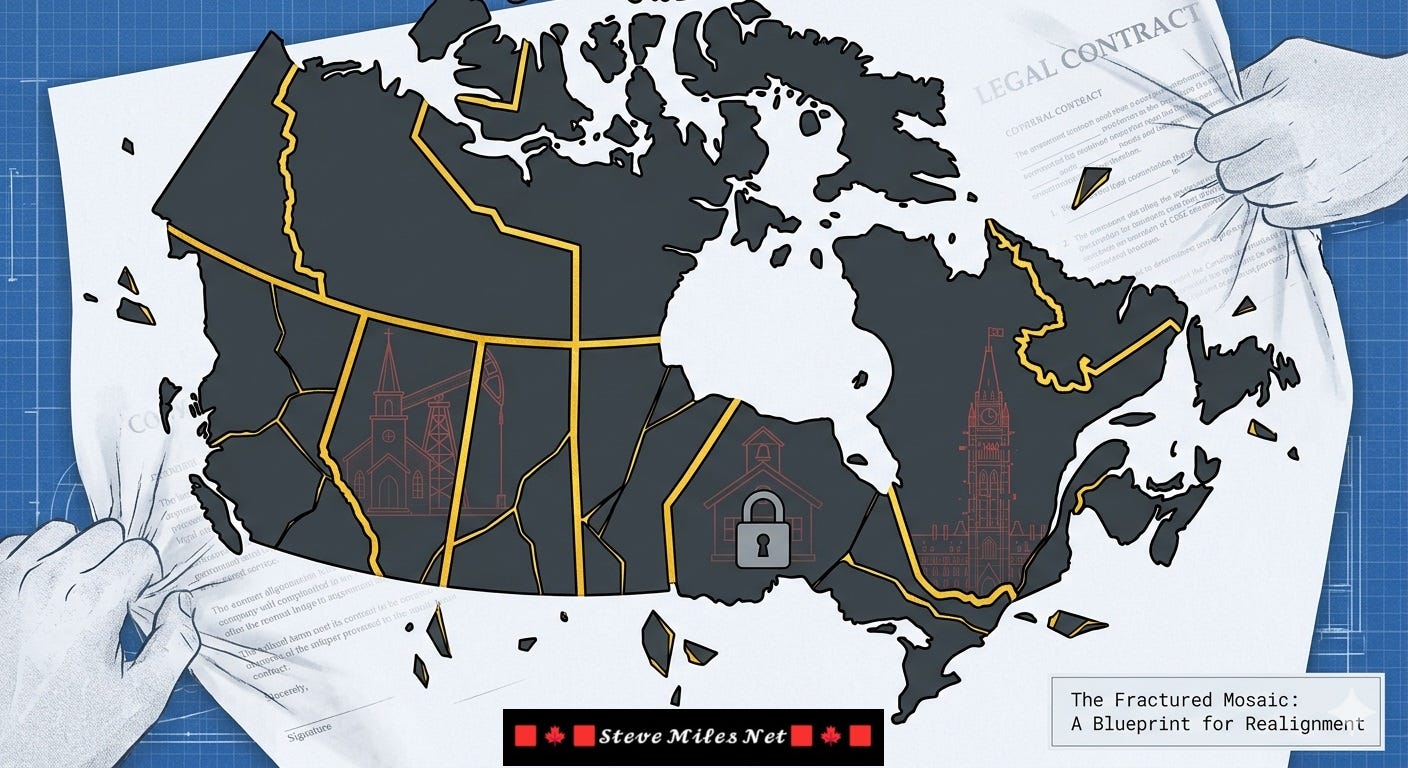
Canada’s political landscape between 2024 and 2026 has undergone a quiet but seismic transformation one not driven by economic upheaval or foreign crisis, but by the deliberate, strategic use of religion to fracture the social contract. What was once a nation defined by secular pluralism and a “peaceable kingdom” consensus is now navigating a new era of identity-based polarization, where faith is no longer a private matter but a political weapon. Conservative actors, led by Pierre Poilievre, have weaponized religious identity to construct a multi-faith coalition united not by doctrine, but by grievance a coalition that sees the state not as protector, but as persecutor.
At the heart of this shift is the “broken Canada” narrative a rhetorical framework that frames the nation as morally and institutionally decayed, in desperate need of restoration. Poilievre’s repeated invocation of a “broken” Canada resonated not just with voters frustrated by inflation and housing, but with those who feel culturally displaced particularly conservative Christians who perceive the state as actively erasing their heritage. By accusing the Liberal government of “erasing Canada’s past,” conservatives have tapped into a deep-seated anxiety: that secular liberalism is not just indifferent to faith, but hostile to it. This narrative is amplified by claims however contested that Christians are now the “number one” victims of hate-based violence, a framing that elevates Christian suffering above that of Jewish and Muslim communities, whose hate crime rates remain higher according to Statistics Canada. The goal is not accuracy, but alignment to create a hierarchy of victimhood that pits religious groups against each other and against the state.
The parental rights movement has become the most effective vehicle for this fragmentation. What began as a legal principle the right of parents to guide their children’s upbringing has been repurposed into a broad, multi-faith crusade against “woke indoctrination” in schools. Conservative leaders, from Poilievre to provincial premiers like Scott Moe, have embraced this cause, positioning themselves as defenders of “sacred texts” and “freedom of conscience.” The “1 Million March 4 Children” protests, backed by organizations like 4Canada and the Campaign Life Coalition, have united conservative Christians, Muslims, and others under the banner of protecting children not from harm, but from gender-inclusive education. The message is clear: the state has no right to interfere in the moral upbringing of children, and any policy that does whether it’s allowing students to change pronouns or teaching about sexual orientation is an assault on religious freedom.
This strategy is not accidental. It is supported by a sophisticated network of think tanks, activists, and legal organizations Cardus, the Justice Centre for Constitutional Freedoms, LifeSite News that provide the intellectual scaffolding for conservative mobilization. These groups frame faith not as a spiritual matter, but as a civic good deserving of state protection and tax-exempt status. They promote a vision of society where private charity and religious institutions replace public programs, where “prosperity theology” justifies austerity, and where moral duty trumps social rights. The result is a moral hierarchy that values voluntary charity over institutionalized support a vision that divides Canadians by suggesting that those who rely on the state are morally inferior.
Regionally, the fragmentation takes on distinct forms. In Alberta, evangelical Christianity and extractive populism are deeply intertwined, creating a “God’s Province” where faith and oil wealth reinforce each other. In Quebec, the state’s strict secularism embodied in Bill 21 is used by conservatives to claim that all faiths are under siege, even as provincial governments in the West push for religious school choice and parental consent laws. This regional dialectic allows the Conservative Party to maintain a “big tent” coalition appealing to Alberta’s evangelicals, Quebec’s secular nationalists, and Ontario’s religious conservatives all while maintaining a consistent narrative of a “broken” and “overreaching” central government.
The influence of the United States is undeniable. The “Americanization” of Canadian conservatism fueled by online disinformation and the rise of a “MAHA” (Make America Healthy Again) movement has brought Christian nationalist ideologies into the mainstream. Poilievre’s visits to churches, his pledge to stop the “censoring of Bible verses,” and his alignment with far-right worldviews signal a strategic embrace of these forces, even if he stops short of calling for a “Christian nation.” The result is a movement that mirrors the U.S. religious right but with a Canadian twist: a multi-faith coalition that seeks to redefine the public square not as secular, but as religiously plural yet still dominated by conservative values.
Yet this strategy is not without cost. The 2026 realignment in which the Liberals flipped a 25-point deficit into a 20-point lead suggests that while religious-based polarization can energize a core, it can also alienate the broader electorate. Disinformation campaigns, “post-truth” narratives about “woke teachers” and “criminalized faith,” and the increasing radicalization of the Conservative base have created a “trust gap” among moderate voters. The Liberals, by focusing on economic growth and affordability, have positioned themselves as the party of stability while the Conservatives grapple with the instability they helped create.
Not all religious communities have aligned with this fragmentation. The United Church of Canada, progressive Catholic organizations, and Muslim groups focused on systemic Islamophobia have resisted the fusion of faith and far-right politics, advocating instead for social justice, reconciliation, and inclusive community. These voices remind us that religion is not a monolith and that the conservative effort to divide Canadians using faith often begins by dividing religious communities themselves.
The future of Canadian politics will be defined by the struggle between two visions: one that seeks to restore a “moral order” by fragmenting public institutions into religious spheres, and another that seeks a “bloodless” centrist majority built on economic stability and secular rights. The “peaceable kingdom” of the past has been replaced by a more polarized and fractured mosaic where the boundaries of faith and the boundaries of the state are constantly being redrawn for partisan advantage. Whether this is a temporary correction or a permanent realignment remains to be seen. What is clear is that Canada’s social contract has been irrevocably altered and that the instrument used to break it was not a policy, but a prayer.